
Comparison8 min read
PureBLAST Mini vs Nano
On this page
Specs at a glance
Spec comparison
Swipe the table sideways to see every column.
| Spec | PureBLAST Nano | PureBLAST Mini |
|---|---|---|
| Operating pressure | 29–145 psi | 29–174 psi |
| Dry ice use | 22–66 lb/hr | 22–66 lb/hr |
| Hopper capacity | 6.6 lb | 17.6 lb |
| Runtime per hopper | ~10 minutes | ~25–35 minutes |
| Power | Air-only | Air + electrical vibrator |
| Air demand (min/ideal/max) | 42 / 92 / 127 CFM | 35 / 71 / 127 CFM |
| Noise level | Not rated (air-only) | ≈75 dBA |
| Footprint (W×D×H) | 13.8 × 13.8 × 18.5 in | 18.9 × 21.7 × 24–35.2 in |
| Weight | 42 lb | 86 lb |
| Included nozzles | 4 mm, 5 mm | 4 mm, 5 mm |
When to choose the PureBLAST Nano
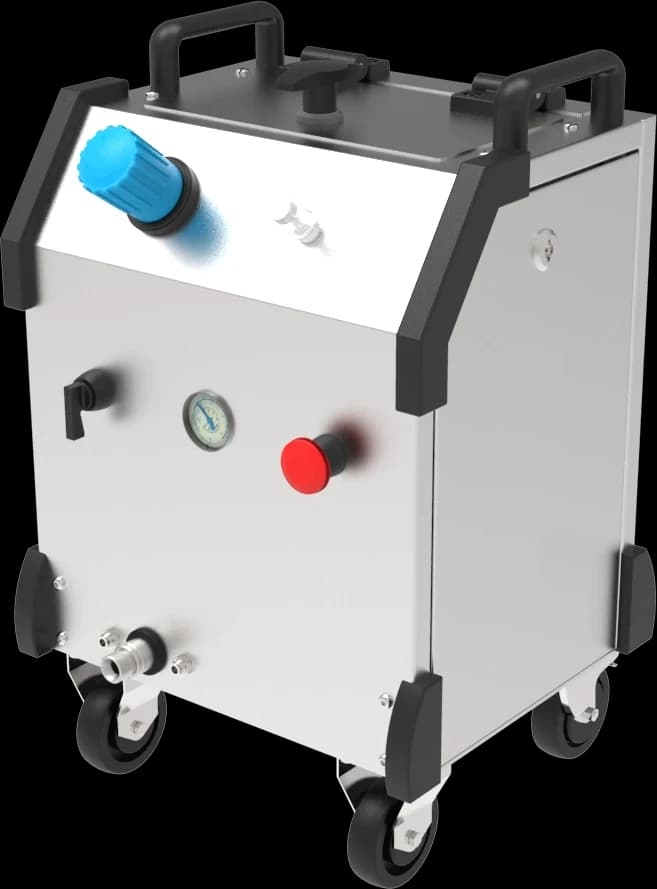
The Nano is the smaller, lighter, simpler unit, intentionally. No electrical requirement, so it can be deployed anywhere you have compressed air. At 42 lb and under 19 inches tall, it's the only PureBLAST you'd carry into a machine cell one-handed.
Pick it when:
- You need mobility > throughput: touch-ups, not long cleans.
- No electrical hookup is available at the work site.
- Your typical cleaning session is under 10 minutes.
- Physical access is tight (electronics enclosures, machine cells, behind guards).
Typical buyers: maintenance technicians who visit multiple cells per shift; electronics-focused assembly shops; service providers who load the machine in a van.
When to choose the PureBLAST Mini
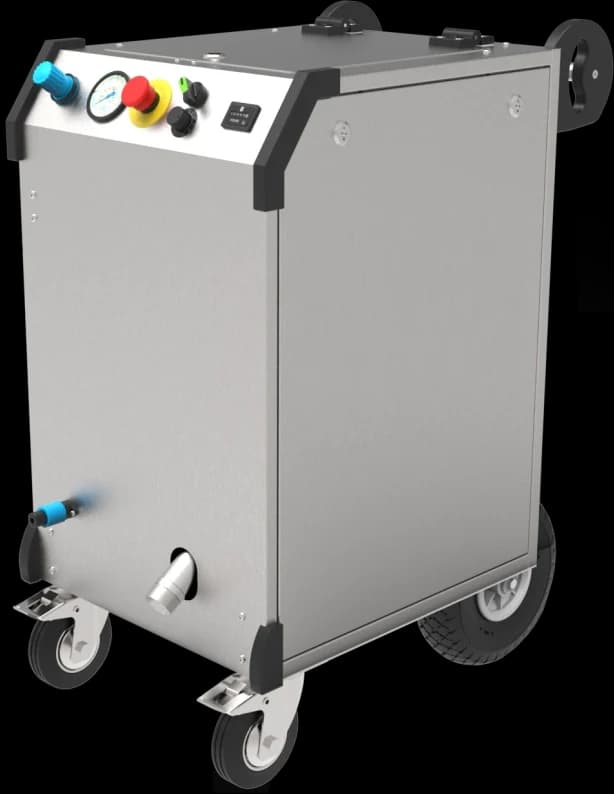
The Mini trades portability for endurance. The bigger hopper (17.6 lb vs 6.6 lb) means 2.5–3× more runtime between refills. The electrical vibrator maintains consistent pellet feed at lower pressures.
The ~75 dBA acoustic rating is a real feature: it's the difference between a machine you can run near operators and one you can't.
Pick it when:
- You clean daily or multiple times per shift.
- Typical jobs run 20+ minutes continuously.
- Noise discipline matters (near operators, open shop floor).
- You want consistent blast quality even as the compressor cycles.
Typical buyers: small-to-mid production shops, electronics manufacturing, precision tooling, food processing lines.
Still can't decide? A simple rule
Cleaning is occasional (a few short sessions per week) and portability matters → Nano.
Cleaning is a daily workflow (every shift, 20+ minute sessions) → Mini.
Stripping heavy adhesives or baked-on release agents → step up to the PureBLAST 2500.
Accessories the Nano and Mini share
Both machines accept the same Nano/Mini-specific accessory line, including the curved Nano/Mini nozzle for tight-access work, the wide Nano/Mini nozzle for broader passes, and the pellet crusher for finer media on delicate surfaces. The compact nozzle holder is sized for either machine's kit.
If you upgrade from Nano to Mini later, your accessories come with you.