
Application9 min read
Clean Injection Molds with Dry Ice
Why this method
Why dry ice blasting for injection molds?
Injection molds get fouled by release agents, plasticizer migration, mold sweat, gas burn, and process residues. Classic options each come with downsides:
- Solvents introduce VOCs and require post-rinse + drying.
- Ultrasonic baths require pulling the tool, often a multi-hour shutdown.
- Manual scraping risks scratching the polished cavity surface.
Dry ice blasting solves all three at once:
- Non-abrasive. CO₂ pellets are 1.5–2 on the Mohs scale, softer than the polished tool steel they're cleaning.
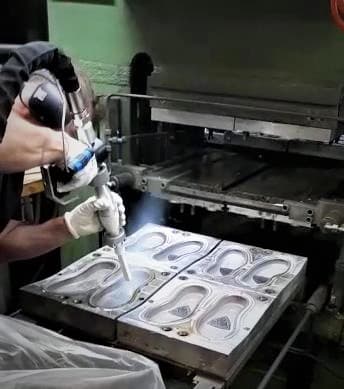
- In-place, hot. Clean while the mold is still on the press at operating temperature. No teardown.
- No secondary waste. Pellets sublimate; only the lifted residue needs handling.
Which PureBLAST machine for which mold?
Swipe the table sideways to see every column.
| Mold size / use case | Recommended machine | Why |
|---|---|---|
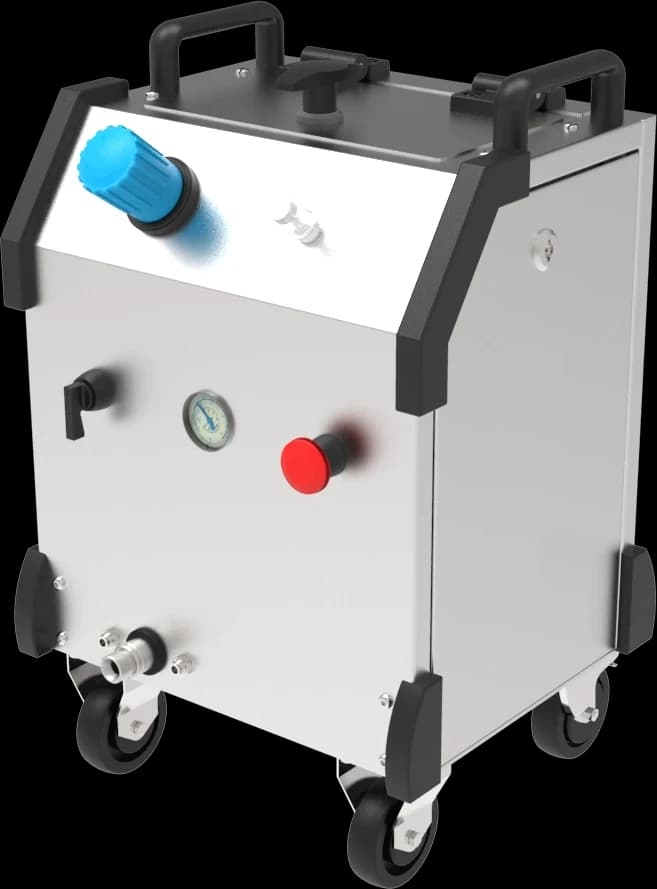
| Small precision tooling, electronics inserts | PureBLAST Mini | Low noise, compact, gentle pressure envelope |
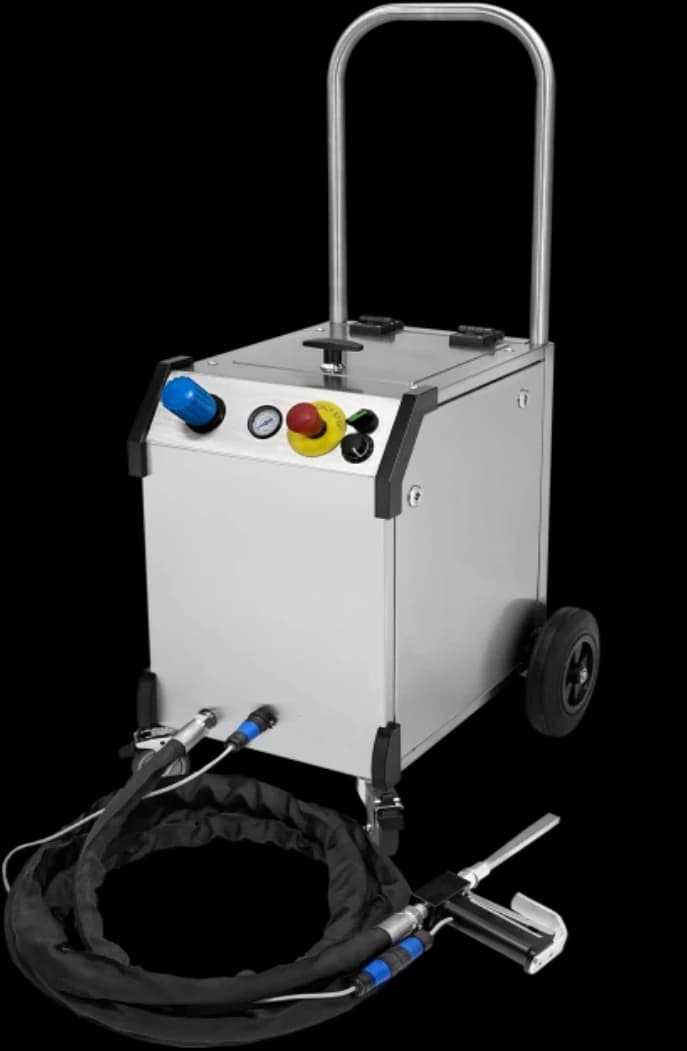
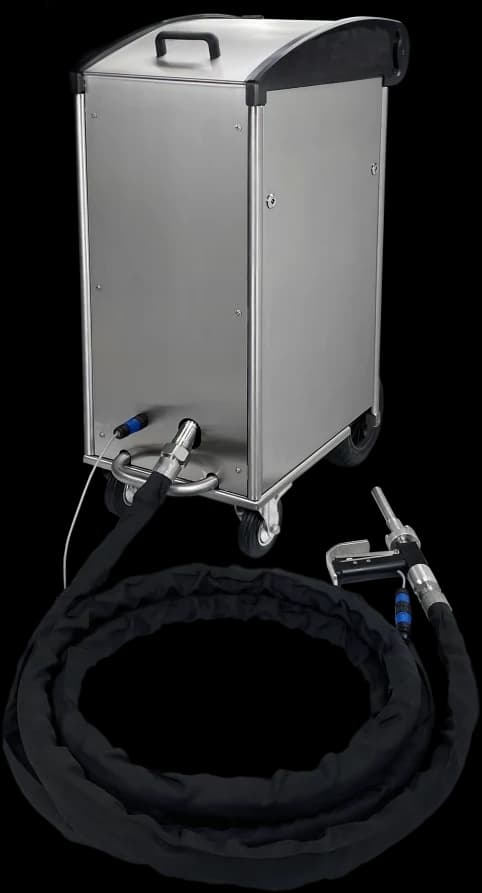
| Mid-cavity production molds (most shops) | PureBLAST 2500 | 174 psi handles release agent and gas burn; 50 lb hopper |
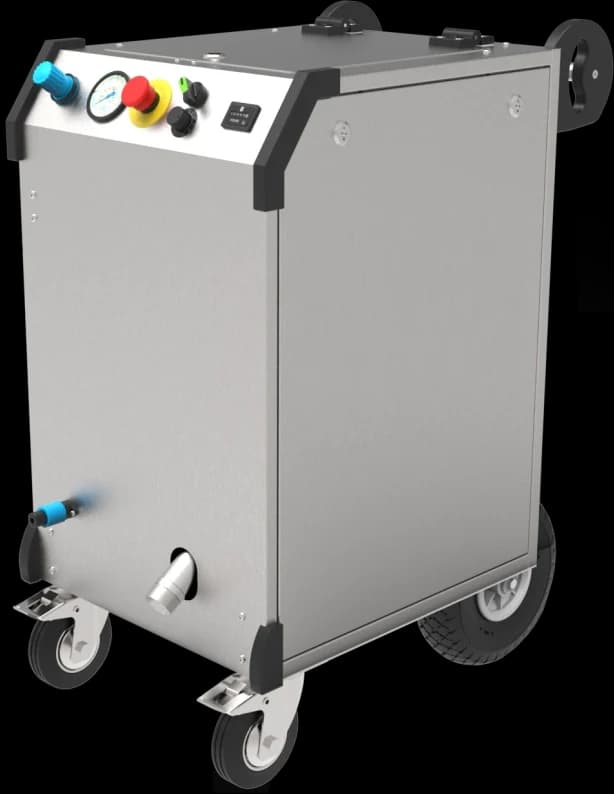
| Large or high-cavity tooling, continuous production | PureBLAST 3000 | 232 psi, narrow chassis fits between presses |
Most injection-molding shops standardize on the 2500 for the bulk of cleaning and add a Mini for delicate parts.
The cleaning process: 5 steps
- Verify mold is at operating temperature. Cold molds are at higher risk of thermal shock from the −78.9 °C (−109 °F) pellets. Most manufacturers spec dry ice cleaning while the tool is at production temperature.
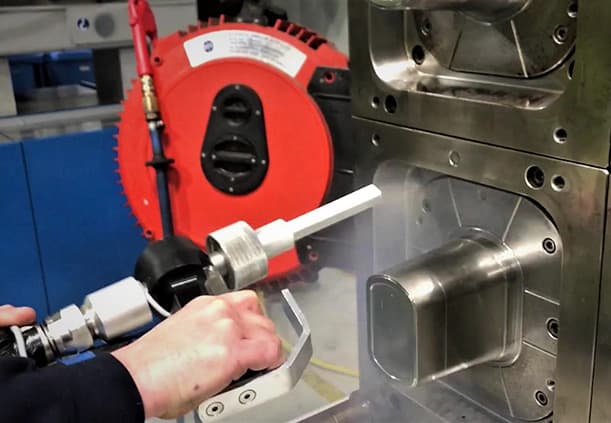
- Select the nozzle. For most cavity work, the short nozzle gives controllable jet width. For hard-to-reach areas inside the mold (slides, ejector pin pockets), the 45° curved nozzle or short curved nozzle gives access without repositioning the press.
- Set pressure conservatively, then increase. Start around 60–80 psi and 8–12 inches standoff. The pellets should lift residue, not impact-mark the surface. Increase pressure only if needed.
- Work systematically. Cavity → slides → ejector area → vents. Don't bounce around, or you'll re-deposit lifted residue.
- Inspect. Visual check + light wipe with a lint-free cloth confirms the surface is clean. Re-blast spot areas as needed.
Total time for a typical mid-cavity mold: 20–40 minutes versus several hours for ultrasonic + drying + reinstall.
How often should you clean?
Frequency depends on your resin, release agent, and how visible cosmetic defects are in the part. Common cadences:
- Engineering resins (PA, PC, ABS) at high cavitation: clean every 2,000–5,000 shots, or once per shift on heavy-cosmetic parts.
- Filled resins (glass-, mineral-, talc-filled): clean every 1,000–3,000 shots: fillers accelerate gas burn and tool deposits.
- Polyolefins (PP, PE) on simple geometry: often only between long campaigns, weekly or per resin change.
The economic argument for shorter intervals: cleaning takes ~30 minutes with dry ice. Letting residue build up means longer cleans, more risk of scrap during the buildup period, and higher probability of needing to pull the tool entirely.
What can go wrong (and how to avoid it)
- Pressure too high. While CO₂ is non-abrasive, an aggressive jet can dent very fine textures (Mold-Tech finishes, EDM textures). Always start conservative.
- Thermal shock on cold molds. If the tool has cooled significantly, the temperature differential can stress shrink-fit components. Clean hot, or warm the tool gradually before blasting.
- CO₂ accumulation in enclosed press cells. Dry ice releases CO₂ as it sublimates. Ensure ventilation per OSHA guidelines (PEL is 5,000 ppm 8-hour TWA).
- Skipping ejector pin pockets. Residue accumulates here first because they're hardest to reach. Use a curved nozzle and explicitly target them.
- Hearing protection. The 2500/3000 are loud (~95 dBA). Operators should wear hearing PPE on every cycle.
ROI for an injection molding shop
Plastic injection is one of the highest-ROI applications for dry ice blasting. Real numbers from multi-cavity shops:
- Cleaning time: 20–40 min in-place vs 2–4 hours with traditional methods (including pull/clean/reinstall).
- Tooling lifespan: Frequent gentle cleaning extends polish life, reducing re-polish cycles.
- Scrap reduction: Cleaner cavities reduce visual defects (gas burn marks, pull marks) on cosmetic surfaces.
- No water risk: No corrosion, no water trapped in cooling channels.
Our Plastic Injection page has an interactive ROI calculator with industry-typical defaults you can adjust.